
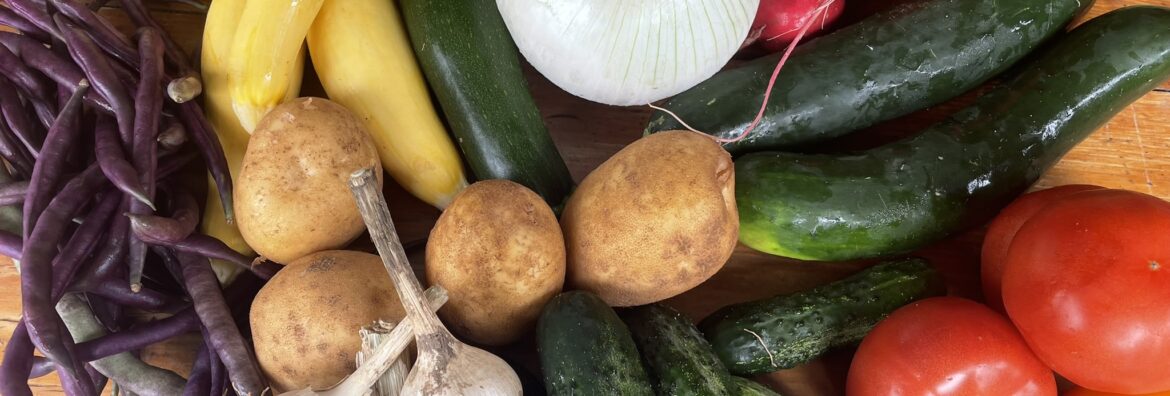
This week’s box includes: Radish bunch, tomatoes, cucumbers (slicers and Kirbys), one huge white onion, summer squash (yellow & zucchini), potatoes, purple green beans, and garlic. You can see a photo that can help with identification on our Facebook page or check out our weekly video on Instagram.
Need storage instructions? Visit our fruit & veggie home pages. Click on the pic and a new page opens with storage instructions and a list of recipes curated by Conne Ward Cameron over the years.
————————————–
Lots of new-to-the-2026-CSA in this week’s box: Kirby cucumbers, potatoes, and green beans – pretty purple ones! Click the links to see a page full of recipes if you’re needing inspiration.
- Kirby cukes are the best pickling cucumber variety. We often just call them “picklers.” Conne Ward Cameron shared her fresh pickle approach with us a while back: wash your cucumbers (whole or in quarters), pop them into a quart jar with some garlic cloves, fresh dill and cover with a brine of about 1 ½ tablespoons kosher salt dissolved in a quart of water. Into the refrigerator they go. In two days you’ll have a nice fresh dill. In 1-2 weeks they’ll be fully brined. They keep in the refrigerator all summer but surely you’ll devour them before then. Store any leftover brine in jars in the refrigerator and you’ll be ready for next week. Kirbys, once they get started, are a weekly inclusion in our CSA boxes.
- Freshly harvested green beans are such a treat – eat them raw with dressing. Their purple color punches up raw vegetable platters but will fade to green when cooked, the perfect excuse for creating a hummus platter this week with raw purple green beans, celery, radishes, and cucumbers.
- On to the fresh potatoes. Store your potatoes in a cool dark place and stockpile them if you need more than this week’s installment for a particular recipe. They keep well and will make frequent appearances in the boxes throughout the summer. But! If you have cabbage or lettuce leftover, consider a pungent Salad Nicoise with green beans and potatoes. Or this Potato and Green Bean Salad which also includes garlic pesto.
Yes, this week, it’s the Riverview garlic that has my attention.
In the South, garlic cloves are planted in the fall. They gather strength over the winter patiently waiting for the warmth of spring. A couple of weeks ago, Charlotte had garlic scapes at the farmers market – a signal that the harvest was nigh.
The scape is the curvy pigtail stem the bulb makes as it tries to shoot into flower. We don’t let it succeed. Scapes are cut off of each individual plant in order to send all that flowering energy back down into the developing bulb. I guess the plant thinks “better luck next year” until plucked from the ground 1-2 weeks later.
Garlic will be in most weekly CSA boxes from now until October. The early bulbs are the juiciest, covered by outer layers that have yet to dehydrate into papers. Peel the outer layers until you get to the gleaming cloves.
Here at our house, a fresh tomato sandwich was the first thing I enjoyed after today’s delivery. Garlic is my secret ingredient. Peel a fresh clove, trim the bottom and rub it onto toasted bread which acts as a microplane grater. Top with fresh tomato slices, mayo, and flaky sea salt. Eat over the kitchen sink. Note about the salt: are you a Maldon convert? It’s the best flaky salt. Whole Foods has a smoked Maldon which is great on this sandwich.
Fresh garlic heralds pesto season. Charlotte’s raving about a pesto she made last week, nothing more than basil, garlic, olive oil, and pecans.
Charlotte’s approach recalls that pesto is a celebration of eating what you have on hand. Years ago in the early days of the Peachtree Road Farmers Market, Leslie Lennox made converts of those unaware of the versatility and ease of pesto via her family’s company, Hope’s Garden. Now she generously shares her pesto creativity In her lovely cookbook “Pesto: The Modern Mother Sauce”.
Leslie advises, “Pesto isn’t so much about a particular configuration of ingredients as it is about making do. What’s seasonal? What tools do I have? What’s left over from last night? In the kitchen, making do isn’t just resourceful, though that is one benefit. It also encourages creative thinking, improvisation, and flexibility—tools that we could all use a little more of.”
Once pesto is in your pantry, you’ve got a flexible flavor bomb for so many dishes. My second sandwich today (yep, you read that right) was turkey, provolone, tomato, avocado, and leftover cilantro pesto. Decadent. Pesto drizzled on tomato + lettuce salad last night was a fun departure from the usual. Pesto butter on steak or burgers, pesto mayo, buttermilk pesto dressing, pesto hummus: so many variations.
So this week, take a look at what you have and whir it up into your kitchen’s personal pesto. Leslie recommends starting with four cups of plants, ½ cup of oil, 2+ garlic cloves, and ¼ teaspoon seasoning. Think broadly about the plants. Those radish tops from this week’s bunch? Yes. Carrot tops are delicious in pesto, too. If you saved your bunch of kale from last week, here’s the link to our Pasta with Kale Pesto recipe.
If the plants you’re using are bitter when uncooked – looking at you collards and kale – add a teaspoon of honey. Freeze unused pesto in ice cube trays and you’ll be ready to garnish cold gazpacho when the peppers start arriving later in the summer.
Classic Basil Pesto
Leslie Lennox, Pesto: The Modern Mother Sauce
4 cups basil leaves
½ cup pine nuts
½ cup grated Parmigiano Reggiano
6 garlic cloves, or to taste
¼ teaspoon salt
¼ teaspoon pepper
½ cup extra virgin olive oil
Combine all the ingredients except the olive oil in a food processor. Pulse for several seconds, until the mixture turns into a paste. Slowly add the olive oil through the feed tube while pulsing, then pulse for about 10 seconds. Scrape down the sides and pulse once or twice more. If you prefer a smoother, looser consistency, add a little more olive oil and continue pulsing. When the pesto is to your liking, use immediately or transfer it to a jar, top with a thin layer of olive oil, cover and refrigerate until ready to use.
***
It’s summer, which means summer squash season. Wondering about yellow squash vs. zucchini? They’re interchangeable in most recipes. The zucchini holds its shape better when cooked. Yellow squash, well, squishes more. Last night I grated 2 large yellow squash on the box grater (large holes), and sauteed it with a pound of ground beef to make sloppy joes. The squash disappears and magically boosts the flavor of the dish.
Leslie’s cookbook shares the recipe below that features zucchini. If you have zucchini on hand, use those to make the boats in this recipe. No zucchini? Array the same ingredients over sliced sauteed yellow squash. We don’t have peppers yet, so feel free to experiment with what you have on hand.
Zucchini Boats Filled with Pesto and Goat Cheese
Leslie Lennox, Pesto: The Modern Mother Sauce
2 medium to large zucchinis
Salt and Pepper, to taste
1 medium white or red onion, thinly sliced
1 bell pepper (any color), seeded and thinly sliced
1 tablespoon olive oil
½ cup crumbled goat cheese, at room temperature
½ cup pesto
¼ cup lightly toasted breadcrumbs or panko
Preheat the oven to 400 F. Line a large rimmed baking sheet with parchment paper or lightly greased aluminum foil.
Cut each zucchini in half lengthwise. Using a small melon baller or spoon, scoop out the center seeds to create a shallow indentation. Season with salt and pepper.
Lay the zucchini halves, cut side down, on half of the prepared baking sheet. Place the onion and bell pepper slices on the other half. Drizzle the olive oil over everything. Season the onion and bell pepper with salt and pepper. Using your hands or a large spoon, toss the onion and bell pepper together.
Roast for 15 minutes, flip over the zucchini, and roast for another 15 minutes. Remove the vegetables from the oven and let them cool for 5 minutes.
While the vegetables cool, blend the goat cheese and pesto in a small bowl.
Fill each zucchini boat with 2 to 4 tablespoons of the pesto mixture, depending on the size of the zucchini. Top with the onion and bell pepper. Finish with the breadcrumbs and serve.
***
Finally, NY Times Cooking comes to the rescue with the salad of the week. Their recipe for Salad-e Shirazi a Persian salad that makes perfect use of the cucumbers, tomatoes and onion in this week’s box. Sounds delicious with grilled fish.
Salad-e Shirazi
NY Times Cooking
3 to 4 Persian cucumbers (about ¾ pound)
½ red onion, diced into ¼-inch pieces
2 tablespoons any combination of finely chopped fresh parsley, cilantro, basil or dill
1 teaspoon dried mint
2 to 3 medium tomatoes (about 1 pound)
¼ cup freshly squeezed lime juice (from about 2 limes), plus more as needed
3 tablespoons extra-virgin olive oil
Fine sea salt and freshly ground black pepper
Remove alternating stripes of peel on cucumbers and trim ends. Dice cucumbers into ¼-inch pieces and place in a large bowl with onion and fresh herbs. Using your fingers to break up any large pieces, gently grind the dried mint into the bowl. Remove tomato cores, dice remaining tomatoes into ¼-inch pieces and add to bowl.
In a small bowl, make a vinaigrette by whisking together ¼ cup lime juice, oil, ¾ teaspoon salt and ¼ teaspoon pepper. Just before serving, dress vegetables with vinaigrette and stir to combine. Taste and adjust seasoning with salt and lime juice as needed. This salad should be bright, crunchy and tart, a nice counterpoint for rich, buttery rice and unctuous stews. Serve at room temperature or lightly chilled. Cover and refrigerate leftovers for up to 2 days.
***
What’s next? I’m looking forward to the first watermelons of the year. Can they be far away? Last year we were rolling in watermelons once they got started. I miss them.
Here’s to enjoying all of your veg this week,
~ Suzanne