
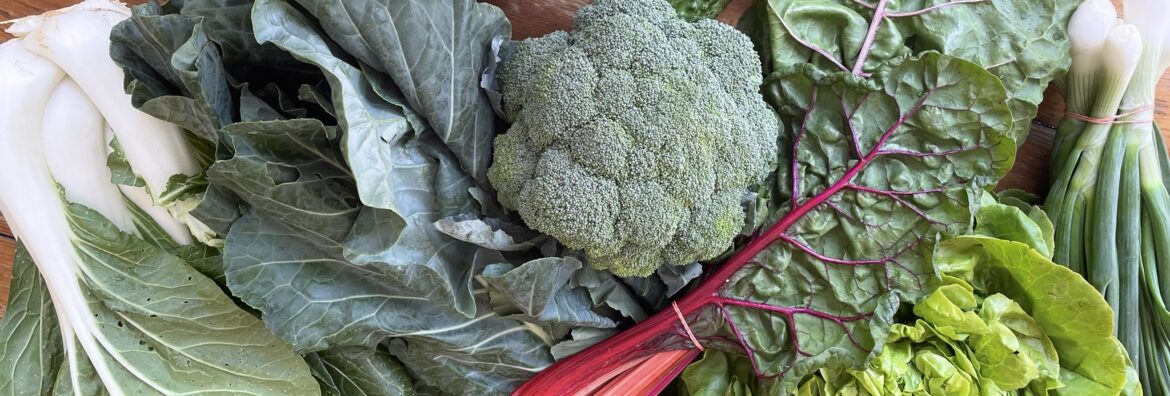
This week’s box included: tomatoes, Swiss chard, cucumbers, spring onions, broccoli (or cauliflower), bok choy (or bag of spring mix/young lettuces), collards, and a head of butter leaf lettuce. You can see a photo that can help with identification on our Facebook page or check out our weekly video on Instagram.
Need storage instructions? Visit our fruit & veggie home pages. Click on the pic and a new page opens with storage instructions and a list of recipes curated by Conne Ward Cameron over the years.
————————————–
Plan of attack based on longevity: The longest keepers this week are the bunch of collards, cucumbers, and broccoli – or maybe you received a head of cauliflower instead? Ditto for it. Into the refrigerator they go. Tomatoes stay out on the counter. They’ll last there the better part of a week. On the other end of the spectrum, that bunch of lovely Swiss chard is best consumed quickly. What a pretty vegetable.
We stress-tested the water bath method for refreshing lettuce last weekend after our petsitter kindly tucked the two heads delivered last week into the refrigerator for us, unprotected. Four long days in the dry arctic winds were completely reversed by trimming the stem end, removing a few outer leaves, and putting the intact head in a cold water bath to soak. Those heads are back in the refrigerator, protected and looking sassy.
Note: If you received a bag of mixed salad greens instead of the bok choy, nick a hole in the bottom of the plastic bag and drain out any moisture that’s collected in the bottom to help those leaves last longer.
——————————-
How wonderful to see the first tomatoes of the season this week! I’m also enjoying watching the spring onions mature; each week’s bunch is larger than the next. Broccoli – or cauliflower – are a fun development, too. Click their links to see plenty of recipes for each, if you’re needing inspiration.
Job #1 in our house is to catch up on last week’s produce. Kale pesto? Topping for burgers, steak, or getting tucked into the freezer as a last resort. I use the flat freeze method: put a sheet of parchment paper on a baking sheet, add separated dollops of pesto to sheet, into the freezer. Once solid, remove the pesto to a bag, seal and return to freezer to quickly season future soups, condiments and sauces.
Collard spring rolls took care of the rest of the leftovers; you can use what you have on hand as fillings. I used quinoa, shredded lettuce, sliced spring onions, cucumber sticks, tofu cubes, sliced radishes & grated carrots. These would be just as delicious with hummus instead of the grains.
Collard Spring Rolls
Collard leaves
Miscellaneous fillings, fresh and/or roasted vegetables
Tofu
Carrot-ginger dressing (recipe below)
Prep each fresh collard leaf by laying it flat on a cutting board, underside of the leaf facing up and stem furthest away from you. (The underside is the side with the prominent stem.) Using a sharp knife laid almost flat, shave off most of the stem so that what’s left is nearly flush with the leaf. Removing most of the stem makes it possible to roll the leaf – don’t skip this step. Trim the extra stem below the leaf so that you’re left with the leaf only. Those trimmed stem ends can be chopped and added to the filling.
Put prepared collard leaves in a large bowl. Pour boiling water over them and soak for 5 minutes. Remove to cutting board, spread out and pat dry.
Mix your chosen filling ingredients in large bowl. Top each leaf with a furrow of filling, add dressing (recipe below), roll like a burrito, and serve.
Carrot Ginger Dressing
Credit Chef Kioyka of Cheffrey’s Kitchen for the inspiration for this dressing. On Sunday she taught a workshop on homemade soba noodles at the Cooks Warehouse, sponsored by Slow Food Atlanta and featuring Artisan Milling’s freshly milled buckwheat. You can find Chef Kioyka and her delicious kaiseki cuisine at the East Atlanta and Grant Park Farmers Markets.
Make enough dressing for leftovers to enjoy later on salad or a simple bowl of sliced cucumbers.
7 ounces carrots, chopped
4 ounces spring onion, chopped
2 tablespoons ginger, peeled and chopped
1 teaspoon honey
1/4 cup soy sauce
1/2 cup rice vinegar
1/2 teaspoon salt
1/2 cup vegetable oil
Blend all ingredients except for the oil in a blender on a lower speed or in a food processor. Ideally there are small pieces of carrot in the mix when finished.
Transfer carrot mixture to pint sized jar. Add the oil, cap and shake to emulsify. Store in the refrigerator for up to a week.
***
The arrival of tomatoes with the spring onions reminds me to share my favorite egg recipe from the archives, Scrambled Eggs with Tomato and Garlic. Pure alchemy – the end result isn’t particularly garlicky, or oniony, or even tomatoey. Just delicious. Even though the recipe calls for an entire bunch of green onions, use half of this week’s bunch instead. The person who wrote the recipe was probably working with those skinny little grocery store bunches.
Finally, Swiss chard. Confession, it’s not been my favorite. We have a couple dozen Swiss chard recipes on our website, including Young Swiss Chard with Sesame Seeds which receives rave reviews every time I bring it to a potluck.
This NY Times Cooking recipe sounds delicious, especially with the rains coming in today.
Creamy Swiss Chard Pasta With Leeks, Tarragon and Lemon Zest
Alexa Weibel, NY Times
Use your spring onions in place of the leeks. Alexa Weibel suggests not skipping the tarragon and lemon zest as they’ll freshen up the recipe; readers substituted dried tarragon with good results. Other herbs that compliment Swiss chard include marjoram, parsley, lovage, and savory.
¾ pound green Swiss chard (1 large bunch), washed and trimmed
2 large leeks (10 to 12 ounces each)
5 tablespoons unsalted butter
½ cup panko bread crumbs
Kosher salt and black pepper
3 tablespoons nutritional yeast
3 garlic cloves, thinly sliced
2 teaspoons fresh thyme leaves
2 cups chicken or vegetable stock
1 cup heavy cream
16 ounces linguine or fettuccine
¾ cup finely grated Parmesan
Fresh tarragon leaves, for garnish
1 lemon, for garnish
Bring a large pot of salted water to a boil. Prepare the chard: Tear the leaves off the stems, separating the leaves and stems. Thinly slice the stems, then coarsely tear the leaves into bite-size pieces. Set both aside in separate bowls.
Prepare the leeks: Trim off the bottom and the dark green portion at the top, halve the remaining white and pale green portion lengthwise, then thinly slice them crosswise. Wash and drain the sliced leeks. Set aside.
Prepare the bread crumbs: In a large skillet, melt 2 tablespoons butter over medium. Add the panko, season lightly with salt and generously with pepper, and cook, stirring occasionally, until golden and toasted, 3 to 4 minutes. Stir in nutritional yeast, then transfer to a paper towel-lined plate.
Wipe out the skillet. Add the remaining 3 tablespoons butter and melt over medium-high. Add the leeks, chard stems, garlic and thyme, season with salt and pepper, and cook, stirring occasionally, until leeks start to wilt and soften, about 5 minutes. Add the torn chard, season with salt and pepper, and cook, stirring, until just wilted, 2 minutes.
Add the stock and heavy cream, and boil over high until thickened, about 10 minutes.
Once the mixture is simmering, add the pasta to the pot of boiling water and cook until al dente. Drain pasta.
Transfer chard mixture to the empty pasta pot. Stir in the cooked pasta, then sprinkle with the Parmesan, stirring vigorously to melt it into the sauce. Season to taste with salt and pepper.
Divide among shallow bowls or plates. Sprinkle generously with the prepared bread crumbs, top with tarragon and grate fresh lemon zest on top. Serve immediately.
***
Here’s to enjoying all of your greens this week!
~Suzanne